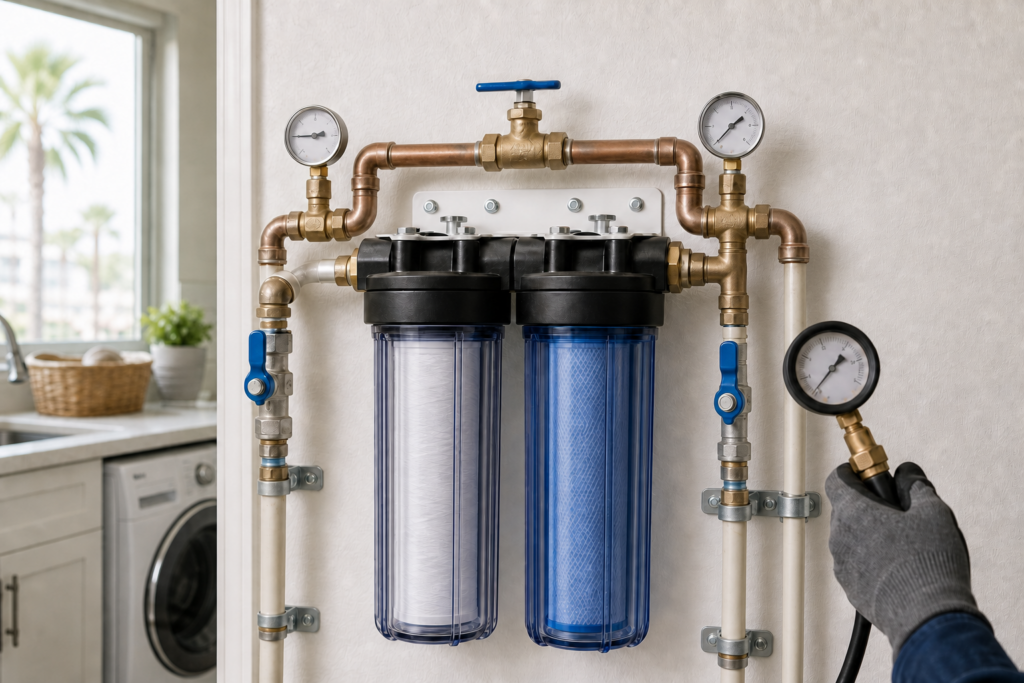

A whole-house water filter may reduce water pressure when the cartridge becomes loaded with debris, a valve is not fully open, the filter or connecting pipework restricts the amount of water the home needs, or another supply problem happens at the same time. The useful question is not simply whether a filter is installed. It is whether pressure drops across that system while water is flowing.
If every faucet and shower became weaker soon after installation or has gradually weakened between filter changes, the filtration equipment deserves inspection. If only one fixture is affected, a clogged aerator, showerhead, supply stop, or fixture cartridge may be more likely. A plumber can compare pressure and flow before and after the filter rather than replacing parts based on the symptom alone.
First Determine Whether the Whole Home Is Affected
Check the pattern during normal use without opening the filter or changing unfamiliar valves. Notice whether the weak flow appears at:
- Both hot and cold taps.
- Fixtures on different floors or in different parts of the home.
- Showers as well as faucets.
- One fixture only.
- Several fixtures only when they run at the same time.
- Every fixture immediately after filter service or installation.
- The whole home gradually as the cartridge ages.
A single weak bathroom faucet usually points in a different direction than every fixture slowing together. If pressure feels normal with one tap open but drops sharply when a second fixture starts, the system may be struggling to deliver the requested flow. That restriction might be at the filter, but the main supply, pressure regulator, shutoff valve, pipework, or a leak can produce a similar pattern.
Also note when the condition began. The date of the last cartridge replacement, recent plumbing work, a water interruption, or a new appliance can help a technician decide where to test first.
A Loaded Cartridge Can Create a Pressure Difference
Water must pass through the filter media before reaching the home’s fixtures. As the media captures sediment and other material it is designed to collect, resistance can increase. The pressure on the outlet side may then fall more while water is moving, especially when a shower, washing machine, or several fixtures need water at once.
That does not mean every old-looking cartridge is the cause. Cartridge appearance, service life, and capacity vary by filter type and water conditions. A newly installed cartridge can also be too restrictive for the required flow, seated incorrectly, or used in a system with another limitation.
Some filter assemblies have pressure gauges on both sides. A meaningful difference between the inlet and outlet readings during a controlled flowing test can support a restriction diagnosis. Static readings taken with no water moving may look similar even when the household experiences weak flow during use. Gauge accuracy must also be considered.
Do not loosen the housing to inspect the cartridge while it is pressurized. Filter housings can hold considerable force, and trapped pressure may release water or the housing unexpectedly. Follow the manufacturer’s shutdown and pressure-relief procedure or have a plumber service the assembly.
Valve Position and Bypass Layout Matter
Whole-house filtration commonly uses isolation valves and may have a bypass arrangement. A valve that is partly closed can reduce flow even when the cartridge is clean. A handle can also appear aligned while an internal valve component is damaged or not operating as expected.
The correct valve positions depend on the piping layout. Turning an unfamiliar bypass can send untreated water into the home, interrupt service, or create an unexpected pressure condition. Do not change the arrangement just to see whether pressure improves unless you understand the equipment instructions and know that using the bypass is appropriate for the household’s water-safety needs.
A plumber can trace the inlet, outlet, and bypass path, confirm that each valve opens fully, and look for a restrictive fitting, backwards component, kinked connector, or assembly problem. Professional water-filter and softener plumbing service can also verify whether the filter is connected in the intended direction and whether the housing is suitable for the installation.
Filter Size and Household Demand Must Work Together
Every cartridge and housing has a flow range and a pressure loss at a given flow. A fine filter can capture smaller particles, but it may also create more resistance than a coarser cartridge. Multiple filtration stages, small ports, undersized connectors, or a compact housing can add restriction when several fixtures operate together.
Peak demand matters. A system that feels acceptable at one sink may perform differently when two showers, a washing machine, and an irrigation connection draw water at the same time. Incoming pressure also changes how much margin the system has before a restriction becomes noticeable.
Avoid choosing a larger housing, different micron rating, or alternate cartridge solely from a general recommendation. The correct choice depends on the equipment, desired treatment, measured flow, water conditions, plumbing size, and household use. Changing filtration media without preserving the treatment goal may create a water-quality tradeoff.
The Filter May Not Be the Cause
Timing can make a filter seem responsible even when another condition is present. A plumber may also evaluate:
- A main shutoff that is not fully open or is failing internally.
- A pressure-reducing valve that is worn, restricted, or set incorrectly.
- A change in the incoming water supply.
- A hidden leak that becomes more noticeable during demand.
- Corroded, scaled, damaged, or undersized piping.
- A water softener or another treatment component installed in series.
- Debris at fixture aerators or showerheads after recent plumbing work.
- A fixture-specific valve or cartridge problem.
Poor pressure throughout an older plumbing system may lead to a broader repiping or rerouting evaluation, but low pressure does not automatically mean the home needs repiping. Measurement should show where the pressure is being lost before a large repair is discussed.
Safe Observations Before Scheduling Service
Useful information can be collected without opening the plumbing system:
- Record whether the problem affects one fixture, one area, or the entire home.
- Note whether hot and cold flow are both affected.
- Observe whether the change appears only when several fixtures run.
- Find the filter brand, model, cartridge type, and service date from visible labels or records.
- Photograph mounted gauge readings with no fixtures running and during ordinary water use, if the gauges are safely visible.
- Look for visible leakage, a cracked housing, unusual movement, or a valve handle that appears out of position without touching it.
- Note any recent filter service, plumbing repair, water interruption, or pressure change.
Do not open the housing, remove a cartridge, adjust a regulator, or force a valve. If a housing is leaking, cracked, or moving under pressure, keep people away from it and shut off the water only if the correct shutoff can be reached and operated safely. Significant water release, structural damage, or electrical exposure requires prompt help.
General homeowner questions can also be compared with Productive Plumbing’s plumbing FAQ, but the filter assembly still needs condition-specific testing when pressure loss repeats.
What a Plumber Can Measure
A service visit may begin with static pressure at a suitable test point and flowing pressure while one or more fixtures operate. When the filter has accessible test points or reliable gauges, comparing the inlet and outlet can show whether a significant drop occurs across the assembly.
The technician may then check valve operation, cartridge service history, housing and port size, direction of flow, bypass configuration, connected treatment equipment, pipe sizing, and visible installation restrictions. If the drop does not occur across the filter, testing can move upstream toward the supply and pressure regulator or downstream toward the home’s piping and fixtures.
The result might support a cartridge service, valve repair, installation correction, equipment-sizing discussion, regulator work, fixture cleaning, leak investigation, or another plumbing repair. A recommendation should identify what was measured and why the proposed work matches the pressure pattern.
When to Call for Water-Filter Plumbing Service in Chula Vista
Schedule service when pressure loss affects several fixtures, returns soon after cartridge service, began immediately after installation, or becomes severe during ordinary household demand. An inspection is also sensible when gauges show a persistent inlet-to-outlet difference, valve positions are uncertain, or the filter housing leaks.
Productive Plumbing provides water-filtration and connected plumbing support in Chula Vista. Share the affected fixtures, timing, cartridge records, visible gauge readings, and recent plumbing changes so the evaluation can begin with the conditions occurring in your home.
Get the Pressure Drop Measured Before Replacing Equipment
If a whole-house filter seems to be reducing water pressure, contact Productive Plumbing. Comparing pressure and flow before and after the filter can separate cartridge, valve, sizing, installation, supply, and household piping causes before equipment or plumbing is replaced.