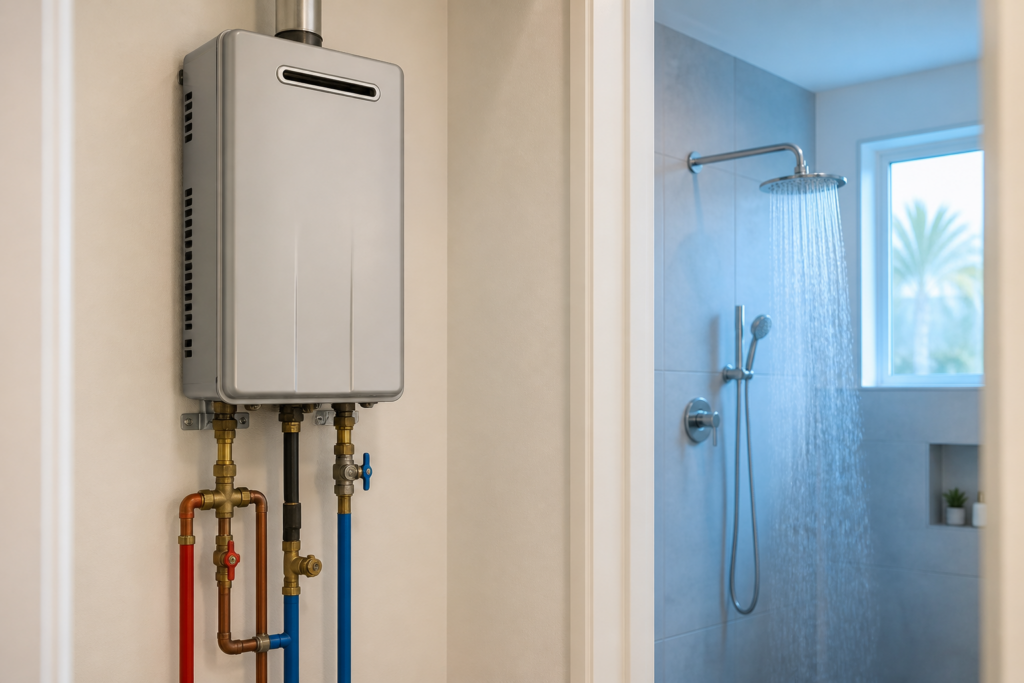

A tankless water heater may turn cold during a shower if the hot-water flow through the unit falls below its operating threshold, other fixtures create more demand than the system can handle at that moment, water flow or heat transfer is restricted, the shower valve mixes in too much cold water, or the unit stops heating after detecting an error. The timing offers useful clues, but it does not identify the failed component by itself.
Start by noticing whether the water becomes fully cold, merely lukewarm, or repeatedly swings between hot and cold. Also check whether the same change happens at another hot-water fixture. A problem limited to one shower may lead the inspection toward its valve or piping. A whole-home loss of hot water makes the tankless unit, its water supply, total demand, or a shutdown condition more important to test.
Do not open the heater cabinet, adjust gas or electrical components, disconnect a vent, operate unfamiliar service valves, or repeatedly reset the unit. If a display shows an error, record it exactly. The code and the way the temperature changed can help a technician reproduce the condition without erasing useful evidence.
First Separate a Cold Drop From a Temperature Dip
The words “turns cold” can describe several different patterns. A complete switch to cold water after a predictable period may mean the unit stopped firing or no longer detected enough hot-water flow. Water that becomes lukewarm only when another shower or appliance starts may point toward total household demand. Rapid hot-and-cold swings at one shower can also involve the shower’s mixing valve.
Record the pattern during ordinary use:
- How long the shower stays hot before the change.
- Whether the water becomes fully cold, lukewarm, or unstable.
- Whether the water volume changes at the same time.
- Whether a washing machine, dishwasher, sink, or second shower started using hot water.
- Whether another faucet still produces hot water while the shower is cold.
- Whether the unit display changes or shows a code.
- Whether the problem happens every time or only under certain conditions.
Avoid repeated tests once the pattern is clear. Each normal-use observation should be brief, and no one should stand under water that may suddenly become too hot. A symptom that includes scalding swings, a leak, an unusual odor, or repeated equipment shutdown calls for service rather than more testing.
Minimum Hot-Water Flow Can Affect Tankless Operation
A tankless heater begins heating when its controls detect enough water moving through the unit. It also needs sufficient flow to continue heating. The exact activation and sustained-flow thresholds vary by equipment and installation, so there is no universal number that applies to every home.
A shower blends hot and cold water to reach a comfortable temperature. If the shower uses a low total flow or mixes in a large share of cold water, the hot portion passing through the heater may become too small for the unit to maintain operation. Heating can pause; after the remaining warm water in the pipe passes, colder water reaches the shower.
That possibility does not mean the showerhead is defective or should be modified. Removing a flow-control component, changing the heater’s setpoint, or altering a valve can create a different temperature or safety problem. A plumber can measure actual hot-side flow and compare it with the manufacturer’s operating requirements before recommending any change.
The sequence itself is useful. If the unit’s burner or heating indicator stops while the shower continues running, the controls may no longer be seeing the expected flow or may have interrupted operation for another reason. Observe the display only from outside the closed cabinet. Do not remove a panel to watch internal components.
Simultaneous Household Demand May Lower the Delivered Temperature
Tankless output depends on both water flow and the temperature increase the unit must provide. When several fixtures request hot water at once, the total flow may exceed what the equipment can heat to the selected temperature under those conditions. The shower may then become cooler, especially if another high-demand fixture begins operating.
This pattern is different from an isolated shower-valve problem. Note whether the temperature changes when another shower, a hot-water faucet, a washing machine, or a dishwasher starts. If hot water returns after the other demand stops, capacity and flow distribution deserve measurement. If the shower stays cold after every other fixture is off, the technician will need to consider other causes as well.
One event does not prove the heater was sized incorrectly. Incoming-water temperature, the requested outlet temperature, total fixture flow, gas or electrical input, control behavior, and installation conditions all affect delivered water. A service evaluation should compare the home’s observed demand with the exact equipment specifications rather than relying on a general household-size rule.
An Inlet or Internal Restriction Can Change Flow and Heating
Water must pass through the cold-water inlet, service valves, inlet screen or filter where equipped, flow-sensing components, and heat exchanger before leaving through the hot-water line. Debris at an inlet screen, a valve that is not fully open, a restricted connector, or accumulation within the water path can reduce flow or interfere with heat transfer. Depending on the unit, the result may be weaker flow, unstable temperature, an error code, or a shutdown.
Mineral accumulation is only one inspection possibility. Its presence and effect cannot be determined from the shower symptom alone, and local water assumptions are not a diagnosis. The maintenance history, measured flow, temperature change across the unit, visible code history, and manufacturer procedures all matter.
Do not remove or clean an inlet screen, connect a flushing pump, add a chemical, or turn service valves based on a general tutorial. Those steps involve pressurized plumbing and equipment-specific procedures. An incorrect valve sequence can release water, interrupt service, or expose internal components to damage. Professional tankless water heater service can test the water path and follow the exact unit’s service requirements.
The Shower Valve May Be the Source of the Temperature Change
When every other hot-water fixture remains stable, the shower deserves its own inspection. Pressure-balancing and thermostatic shower valves are designed to manage the mix of hot and cold water. A worn, sticking, restricted, or incorrectly adjusted cartridge may shift that mix during use. Changes in supply pressure when another fixture opens can also affect how a failing valve behaves.
A shower-specific pattern may include:
- Other faucets remain hot while the shower turns cold.
- Moving the shower handle produces an unusual delay or abrupt temperature change.
- The problem began after valve, cartridge, or showerhead work.
- One shower has the symptom while another shower does not.
- Water volume or handle resistance changes along with temperature.
Do not remove the handle or trim, pull a cartridge, or force a stiff control. Water remains pressurized behind the valve, and the correct cartridge and service method depend on the installed assembly. A plumber can test the heater at another fixture and isolate the shower valve before opening the wall or replacing equipment.
Cold Water Can Cross Into the Hot-Water Piping
A plumbing crossover occurs when cold water enters the hot-water side through a faulty mixing point. A worn single-handle faucet or shower cartridge, an appliance connection, a recirculation arrangement, or a failed check component may create that path. The result can resemble a heater problem because the hot line becomes diluted before water reaches the shower.
Crossover symptoms are not always limited to the fixture where the faulty component is located. A shower may turn cold even though the mixing path is elsewhere. That is why changing the heater first can miss the cause.
Technicians can isolate fixtures or branches and compare temperatures to determine whether cold water is entering the hot side. Homeowners should not close unfamiliar valves or disconnect appliance hoses to perform that test. Those actions can create leaks, damage, or an unexpected loss of water service.
Error Codes and Shutdowns Need Exact, Equipment-Specific Review
A tankless unit may interrupt heating when its controls detect a condition outside its operating range. Depending on the equipment, a visible code may relate to ignition, fuel or electrical supply, airflow or venting, temperature sensing, overheating, water flow, or another monitored function. The same number can mean different things on different makes and models.
Photograph or write down the complete code and note what was running when it appeared. Also record whether the code clears on its own, whether hot water returns later, and whether the shutdown affects every fixture. Do not guess at the meaning from an unrelated model, and do not repeatedly clear the code. Repeated resets can hide the sequence a technician needs and may restart equipment that is stopping for a protective reason.
Stop using the unit and move to a safe location if you smell gas, a carbon-monoxide alarm sounds, soot appears, or an unusual exhaust or burning odor develops. For a gas odor, avoid flames and electrical switches, leave the area, and contact the gas utility or emergency services from a safe location. Follow the alarm manufacturer’s emergency instructions for a carbon-monoxide warning.
Keep away from the heater if water is leaking onto the unit, wiring, a receptacle, or other electrical equipment. Do not touch wet controls, switches, breakers, cords, or panels. A cracked water connection, wet electrical area, damaged vent, or repeated protective shutdown needs professional attention before the heater is used again.
Safe Observations That Help the Diagnosis
Useful information can be collected without removing a cover or changing the system:
- Note the shower, date, and approximate time of the event.
- Record how long the water stays hot and how the temperature changes.
- Note whether the water volume changes at the same moment.
- List any other hot-water fixtures or appliances operating at the time.
- Check from a safe location whether another faucet remains hot.
- Photograph the heater’s visible display and any complete error code.
- Find the model information and service history from records or an exterior label without opening the cabinet.
- Note recent plumbing work, a water interruption, or a change in shower hardware.
- From a distance, look for leakage, discoloration, or an obviously damaged vent without touching the equipment.
Do not raise the temperature setting to compensate for the cold period. Do not remove a shower flow-control component, open the heater cabinet, clean internal parts, descale the unit, move a vent, adjust a gas valve, handle wiring, or operate service valves that are not part of ordinary homeowner use. Those actions can change the symptom and introduce burn, gas, electrical, combustion, or water risks.
How a Plumber Separates the Possible Causes
A useful diagnosis recreates the temperature change under controlled conditions and tests one part of the system at a time. Depending on the equipment and symptom, the technician may:
- Measure hot-water flow while the shower runs.
- Compare inlet and outlet water temperatures.
- Check whether the unit continues to recognize flow when the shower turns cold.
- Review stored and active error information using the correct manufacturer documentation.
- Compare shower-only demand with simultaneous household demand.
- Verify accessible service-valve position and inspect the inlet path according to the equipment procedure.
- Evaluate maintenance history and evidence of restriction without assuming scale is present.
- Test another hot-water fixture to separate heater behavior from the shower valve.
- Isolate possible cold-water crossover points.
- Inspect the shower’s pressure-balancing or thermostatic control when the symptom is fixture-specific.
The result may support a shower-cartridge repair, correction of a crossover, inlet or valve service, manufacturer-specified maintenance, an equipment repair, an installation correction, or a discussion about household demand. It may also show that the unit is operating normally and the temperature change originates elsewhere. The recommendation should follow the measurements instead of the symptom alone.
When to Request Tankless Water Heater Service in Chula Vista
Schedule an evaluation when a shower repeatedly starts hot and turns cold, the condition affects several fixtures, a visible error returns, or hot water does not recover after other demand stops. Service is also appropriate when the symptom began after plumbing or equipment work, the shower temperature swings sharply, or the household cannot reproduce stable hot water during ordinary use.
Stop testing and seek prompt help for a gas odor, carbon-monoxide alarm, soot, abnormal exhaust or burning odor, visible water at the heater, wet electrical components, a damaged vent, or repeated shutdown. The immediate priority in those conditions is safety, not restoring the shower.
Productive Plumbing can evaluate the tankless unit and connected shower plumbing for homeowners in Chula Vista. Share the timing, affected fixtures, simultaneous water use, display code, model information, and recent service history so the visit can begin with the exact pattern occurring in the home.
Get the Temperature and Flow Pattern Checked
If your tankless water heater keeps turning cold during a shower, contact Productive Plumbing. A condition-based inspection can distinguish low hot-water flow, household demand, a restriction, shower-valve behavior, crossover, and equipment interruption before repair or replacement is recommended.